


Environmental justice is a basic health and human right that ensures that everyone is entitled to breathe clean air, have safe drinking water, and live on uncontaminated land. It is not a difficult concept to grasp, but it is critically important and faces significant opposition. Big oil and other polluting industries are manipulating and undermining environmental justice communities as they pursue their own selfish ends for bigger and bigger profits. They protect their industry profits and bottom lines by any and every means possible, at the expense of the health of frontline communities and the environment.
Although big oil and other polluting industries have significant resources and have influenced policies in their favor for decades, we can learn and grow beyond our current systems to create a more just and equitable California. We can imagine and create systems that integrate environmental justice with equitable development practices – as described further below – so that California can do growth responsibly, with health, economic, and environmental benefits for all residents.
How We Got Here…The False Choices in California’s Broken Land Use Policies
California’s land-use policy and permitting system is broken. A long history of racist planning and zoning policies has resulted in the landscape we see today, where certain communities are sacrificed so whiter and wealthier communities do not experience the health and pollution burden of industry as corporations maximize their shareholder and executive profits without responsibility or consequence to Californians who live in sacrifice zones. These policies have consistently placed polluting industries and other toxic land uses in the middle of low-income communities and communities of color, increasing economic and health disparities in these neighborhoods. Communities in these landscapes are environmental justice (EJ) communities. Under CA statute, these communities are also designated as disadvantaged communities (DACs) using data based on geographic, socioeconomic, public health, and environmental hazard criteria in CalEPA’s CalEnviro Screens tool. For too long, EJ communities and DACs have shouldered a disproportionate burden of the fallout from the climate crisis, pollution, toxic sites, and high-impact development, while others are protected.
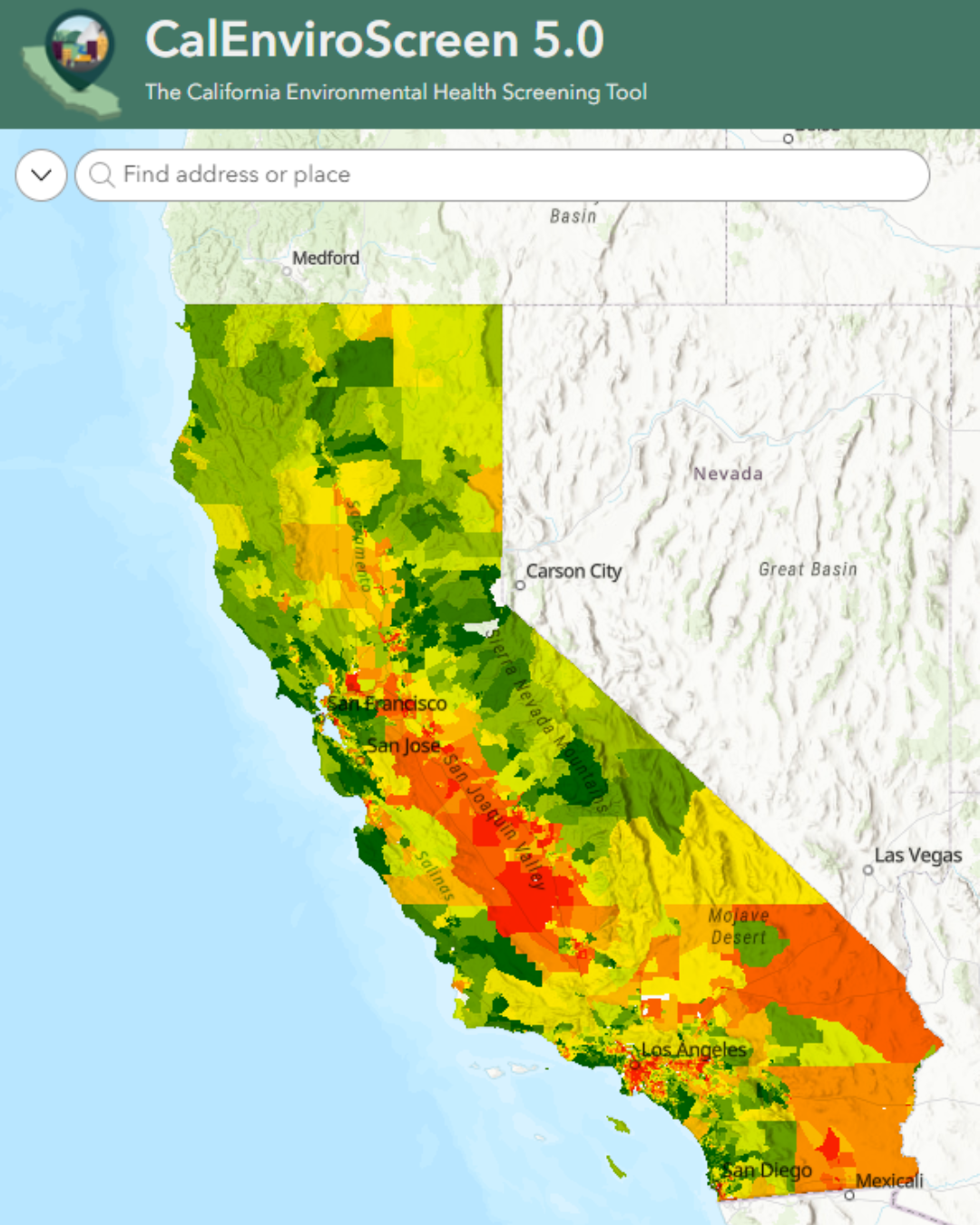
Photo Credit: CalEnviroScreen 5.0 Web App
The consequences of industry’s unchecked development, including before basic environmental laws were established, are evident in the growing health disparities, racial inequities, and economic inequities that families and entire communities experience when they are forced to live near freeways, warehouses, and industrial zones. According to a 2021 analysis of CalEnviro Screens 4.0 Data by CalEPA, 90% of people living in impacted communities (DACs) are people of color, underlining the racial justice roots of environmental injustices. Data also reveals, as documented in a 2025 report by the UCLA Latino Policy & Politics Institute (Climate Change and Health Disparities in California’s Latino Neighborhoods), that these same communities have a much higher exposure to health and environmental risks than do non-Latino white neighborhoods.
A tangible example of such impacts can be found in the City of Vernon, where the Exide Technologies Battery Recycling plant operated for decades. The plant’s operations spread lead into nearby homes in Southeast and East Los Angeles and have now cost taxpayers nearly $1 billion to clean up decades of pollution. Even more recently, the Lineage Logistics warehouse in Boyle Heights, positioned adjacent to residential communities, burned for days, leaving millions of tons of food waste to rot in the hot summer sun. Due to the fire, residents experienced severe health issues like respiratory infections, eye disorders, persistent coughs, and asthma exacerbation. Unfortunately, these types of health impacts from polluting projects are common in frontline communities, which are disproportionately low-income and communities of color.
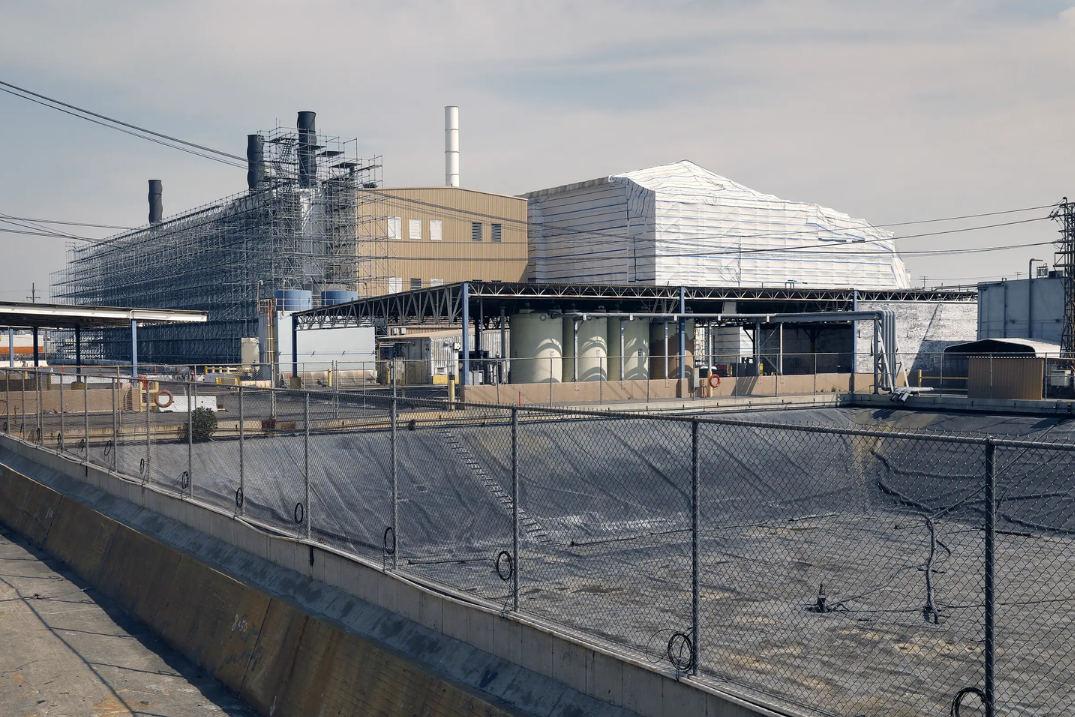
Photo Credit: Al Seib - Los Angeles Times
For decades, these same communities relied on California’s environmental laws, like the California Environmental Quality Act (CEQA), to protect themselves. CEQA allowed them to identify and reduce the health and environmental harms of major polluting projects before they get built. However, with constant industry attacks, such as last year’s SB 131 (a budget trailer bill), such key environmental protections are being quietly stripped away in pursuit of a definition of “growth” that mostly results in industry profit at the expense of frontline communities’ health. Senate Bill 131, passed in 2025, carved out a sweeping exemption from CEQA for “advanced manufacturing” facilities, including chemical recycling plants, waste incinerators, strip mining operations, defense manufacturing, biomass facilities, and nuclear/fusion manufacturing. These projects can now proceed without the environmental review process that has protected Californians for over 50 years.
SB 954’s Veto Warns of The Struggle Ahead to Protect Frontline Communities’ Health, Workers’ Rights, and Affordability for All Californians
In response to the overly broad SB 131, legislators left the 2025 session with a promise to address the concerns raised by environmental justice, environmental, and labor advocates. State Senator Catherine Blakespear’s SB 954 would have established guardrails to ensure that only the less polluting, less risky manufacturing activities would receive reduced environmental review with specific, hard-won protections for the communities whose health is most at risk from industrial pollution. This bill was an actionable vision that tied together the importance of protecting public health, environmental justice, and worker justice in service of establishing a thriving, regenerative economy.
SB 954 did not shut the door on manufacturing. It refused to let manufacturing growth happen at the expense of the people living next to it.
Unfortunately, Governor Newsom vetoed this bill, overriding the intent and vote of a supermajority of the legislature. While this is a frustrating setback for all Californians who fought hard to protect their health and the environment, especially for frontline communities, ensuring community protections during economic growth remains a priority.
The Conversation We Need From California’s Decision-Makers
Environmental justice communities want, and need, development. We are not against it. Rather, we want it done responsibly. What we need is equitable development (such as the principles developed by community members in South Los Angeles) – development that is done right; that prevents health and environmental harms, displacement, and gentrification; and that provides benefits to all community members regardless of race/ethnicity, class, gender, and economic status. The way in which land use decisions are made is critical to ensuring this happens. We cannot consider the impact of land use policies on the economy without also considering the inherent connection to housing needs, public health, and the environment. Therefore, we must adhere to these principles and integrate them with EJ needs.

Image Credit: The People's Plan: Equitable Development in South Los Angeles, Unidad LA
As frontline communities are well aware, the connection between – or rather, the cumulative impact of the ways in which these issues interact with one another, either furthered or hindered by land use policies, is the very essence of what environmental justice policies seek to maximize for the benefit of all Californians. However, when these policies are based on inequities and center industry profit over people, we see that the one broken system results in multiple, overlapping crises, such as the housing crisis, climate crisis, and economic crisis. They can only be healed and redressed through policies that include frontline and other impacted communities in decision-making, a key part of both EJ and equitable development practices. To resolve them, policy solutions must prioritize regenerative practices for the land and the people over extractive ones that have only centered corporate profits at the expense of people’s lives.
The answer is not to weaken safeguards in the name of “streamlining” and “abundance,” but to improve the system so that it is transparent, democratic, regenerative, and centered on public health, environmental justice, housing justice, and workers’ rights. We need a system that considers cumulative health and economic impacts and ensures that our policies benefit all Californians, rather than sacrifice their basic needs for industry profit. California can build what it needs and ensure everyone benefits regardless of race, class, or economic status. No community needs to be sacrificed to make this a reality. Land use decision-making must be fixed to redress past harms and to build toward a just and equitable future for all Californians.
Growth and protection are not in conflict. However, industry talking points aim to make us believe and perpetuate this myth, creating a false choice between our health and our jobs, our homes and economic stability. The truth is simple. Industry wants us to support their harmful, toxic, polluting practices. Their cynical ploy to advance their own selfish means is to distract us with policy-making that forces a choice between environmental justice and industry profit. We call on lawmakers to reject this false dichotomy.
Even while we contend with industrial polluters attacking bedrock environmental justice laws, we take lessons from California’s strong history of fighting for environmental justice, including CEQA. For example, in 2018 the state’s Attorney General’s office, through its Environmental Justice Unit, intervened in a case challenging a city’s approval of an industrial project near already environmentally burdened neighborhoods. The EJ Unit, through this case, demonstrated how important CEQA is to promote environmental quality equitably and effectively.
Equipped with the knowledge of the past and vision for the future, we have hope for the next administration to build protections for frontline communities.
A Chance to Make Transformative History
California has positioned itself as the leader in resisting the federal government’s rollback of the protections that keep people safe and the unchecked drive to protect profits for polluting industries. Passing SB 954 was a chance to show true commitment to this stance. Vetoing it creates a blatant contradiction that is not lost on us and, certainly not on the frontline communities that have spent the last year hoping the Governor was on their side.
In addition to SB 954 being vetoed, protections for California’s frontline communities face another threat at the ballot box. Proposition 45 is another corporate manipulation of our democratic processes. Prop 45 is led by oil, gas, utility, and data center corporations to weaken our environmental protections. It will effectively take away CEQA, which is the strongest tool frontline communities use to protect ourselves from the worst health impacts from polluting projects. Prop 45 will dismantle public input and government oversight Californians depend on, lessening our ability to reduce polluting projects that will harm our families for generations to come.

Image Credit: No on Prop 45 Campaign
Despite SB 954 being vetoed and Prop 45 pending the November election results, we have hope for the future. We know that our collective voices will drive us toward positive change and ensure this state fulfills its promise for all residents to live with environmental justice and free from the health and toxic harms of big industry.
One of many tangible policy changes to help bring this future to life includes ensuring protections for communities where the health, economic, and pollution burden data designate those areas as disadvantaged communities according to the state’s CalEnviro Screens mapping tool. This would include ensuring full environmental review for proposed developments, should they fall within or near such communities and other sensitive land uses (e.g., schools, hospitals, homes). The environmental review process improves the projects for community benefit and to mitigate or avoid environmental hazards. SB 954 tried to stay consistent with these policy principles, as did other bills during this legislative session, such as AB 2170 by Assemblymember Boerner.
Most importantly, to truly center those most impacted by the climate crisis and industrial pollution, we must have policies that center the principles of environmental justice. The voices of frontline communities – those most impacted by systemic inequities that have created the current crisis of environmental racism – must be included in land-use decision-making and in shaping development coming into their neighborhoods and directly affecting their homes, their communities, and their health. The Jemez Principles for Democratic Organizing, developed in 1996 at the “Working Group Meeting on Globalization and Trade” in Jemez, New Mexico, clearly articulate the process by which to do this. And, by centering the voices of EJ communities, we will be able to transform our systemic approach to land use from being inequitable to one that is transparent, democratic, regenerative, and centered on public health, environmental justice, housing justice, and workers’ rights. In this way, we will heal the land and heal the people.
We – the California Environmental Justice Alliance, an alliance of grassroots environmental justice organizations throughout the state who live and work in frontline communities – invite our Legislators, both seasoned and the incoming freshman class, and our new incoming Governor to join us in making this state a healthy, thriving one. Together, we can make our state a refuge and a home for all Californians, regardless of their race, ethnicity, gender, class, or whether they live in urban or rural areas. We all deserve to live in a place where our air, water, and soil are free of contamination.
